Learning and the Law of Effect
Learning and the Law of Effect
Did you know that the law of effect, one of the six laws of learning, has a significant impact on instructional design and behavior shaping? It states that behaviors with satisfying outcomes are more likely to be repeated, while those with unsatisfying outcomes are less likely to reoccur. This principle of psychology reveals why we repeat certain behaviors and not others, making it a crucial consideration in education and behavior change.
Key Takeaways:
The law of effect states that behaviors with satisfying outcomes are more likely to be repeated.
It plays a crucial role in instructional design and behavior shaping.
Positive reinforcement is key to encouraging desired behaviors.
Understanding the law of effect can enhance student motivation and promote skill acquisition.
Behavior change can be achieved by applying the principles of reinforcement and punishment.
The Six Laws of Learning
When it comes to instructional design, the six laws of learning serve as fundamental principles that guide the creation of effective instruction. These laws play a crucial role in facilitating learning. They must be taken into consideration when designing instructional materials and activities. (Click on a law to learn more.)
The Law of Exercise: This law emphasizes the importance of repetition and practice in learning. The more frequently a stimulus and response are associated, the stronger the association becomes.
The Law of Effect:This law states that positive reinforcement increases the likelihood of repeated behavior, while negative reinforcement decreases it.
The Law of Readiness: According to this law, learners must be mentally and physically ready to learn to effectively acquire and retain information.
The Law of Primacy: The law of primacy dictates that information learned first is more likely to be remembered and have a lasting impact.
The Law of Intensity:This law suggests that intense and emotionally charged experiences are more memorable and impactful for learners.
The Law of Recency: The law of recency emphasizes that information learned most recently is more likely to be retained and recalled.
The Law of Effect and Behaviorism
The law of effect had a significant impact on the development of behaviorism, a psychological school of thought that emphasizes conditioning and reinforcement. B.F. Skinner, one of the key figures in behaviorism, based his theory of operant conditioning on the law of effect. Operant conditioning focuses on modifying behaviors through reinforcement and punishment, with the law of effect serving as a foundation for understanding how behaviors can be strengthened or weakened based on their consequences.
According to Skinner's theory, behavior is shaped by the consequences that follow it. Positive consequences, such as rewards or praise, serve to reinforce and increase the likelihood of a behavior being repeated. On the other hand, negative consequences, such as punishments or criticism, discourage and reduce the likelihood of a behavior occurring again.
Skinner's operant conditioning principles, rooted in the law of effect, have applications in various fields, including education, psychology, and even animal training. By understanding how behaviors are influenced by their consequences, behaviorists can develop strategies to modify and shape behavior effectively. This approach has been widely used in behavioral interventions, therapy, and instructional design.
“The law of effect provides a fundamental understanding of how reinforcement and punishment influence behavior, giving behaviorism a solid theoretical framework.” - B.F. Skinner.
The Law of Effect and Reinforcement
The law of effect highlights the significant role that reinforcement plays in shaping behavior. When a behavior is followed by positive or reinforcing consequences, it is more likely to be repeated in the future. Conversely, behaviors that are followed by negative or punishing consequences are less likely to be repeated.
This principle underscores the importance of positive reinforcement in encouraging desired behaviors. By providing positive consequences for behaviors we want to reinforce, we increase the likelihood of those behaviors being repeated. Positive reinforcement can take various forms including rewards, praise, or recognition. It serves as a powerful motivator, encouraging individuals to continue engaging in desired behaviors.
On the other hand, negative consequences or punishments can discourage undesired behaviors. When a behavior is followed by a negative consequence, such as a reprimand or loss of privileges, it decreases the likelihood of that behavior recurring in the future. Negative consequences serve as a deterrent, reinforcing the idea that certain behaviors have negative outcomes or implications.
Reinforcement is a vital tool in behavioral psychology. It allows us to shape behavior by providing outcomes that either strengthen or weaken specific behaviors. The law of effect recognizes the power of reinforcement in influencing human behavior.
In the context of instructional design, reinforcement plays a critical role in creating effective learning experiences. By incorporating positive reinforcement into the learning process, instructors can motivate learners and reinforce desired behaviors. This can be achieved through various techniques such as praise, rewards, or gamification elements. Positive reinforcement not only increases engagement but also enhances learning outcomes by creating a positive and enjoyable learning environment.
However, it is essential to use reinforcement judiciously and strike a balance between positive reinforcement and punishment. In some cases, excessive positive reinforcement may lead to an over-reliance on rewards, potentially undermining intrinsic motivation. It is important to foster a sense of internal motivation and enjoyment for learning while still utilizing reinforcement strategies to reinforce specific behaviors.
Applying the Law of Effect in Learning
The law of effect has practical applications in education. Instructors can use the principles of positive reinforcement to encourage positive behaviors and discourage undesirable ones. By providing positive consequences and rewards for desired behaviors, instructors can increase the likelihood of those behaviors being repeated. This approach helps create a positive learning environment and motivates learners to engage in desired behaviors.
The law of effect informs effective instructional strategies and instructional design. When instructional designers understand the impact of reinforcement on behavior, they can design learning experiences that promote desired outcomes. By incorporating positive reinforcement techniques such as praise, rewards, and recognition, instructors can motivate learners and foster a love for learning.
Positive reinforcement is a powerful tool in education. It helps learners associate positive outcomes with their efforts and achievements, leading to increased engagement and a desire to perform well.
Instructors can apply the law of effect by establishing clear expectations, providing regular feedback, and implementing a system of rewards and recognition for desired behaviors. When learners consistently experience positive consequences for their actions, they are more likely to repeat those behaviors and develop positive habits.
Creating a Positive Learning Environment
In order to effectively apply the law of effect, instructors must create a positive learning environment. This involves cultivating a supportive and nurturing classroom atmosphere where learners feel valued and respected. By building strong relationships with learners and creating a sense of belonging, instructors can enhance the effectiveness of positive reinforcement.
Additionally, instructors should focus on providing constructive feedback and guidance to help learners understand the connection between their actions and the outcomes they experience. By helping learners make these connections, instructors can empower them to take ownership of their learning and behavior.
Overall, the law of effect offers valuable insights into how instructors can create effective instructional strategies and design that promote positive behaviors in the classroom. By utilizing positive reinforcement techniques and fostering a positive learning environment, instructors can motivate learners, enhance engagement, and facilitate meaningful learning experiences..
The Law of Effect and the Learner
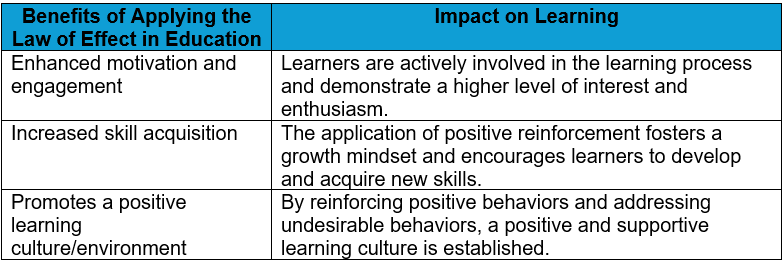
The law of effect provides valuable guidance for instructors in supporting learners. By understanding and utilizing the principles of reinforcement and punishment, instructors can effectively motivate learners to engage in desired behaviors and discourage undesired behaviors. The law of effect emphasizes the importance of providing positive outcomes and rewards to reinforce desired behaviors and create a sense of accomplishment, ultimately enhancing student motivation and promoting skill acquisition.
By implementing strategies that align with the principles of the law of effect, instructors can create a positive learning environment that fosters student engagement and academic success. When learners experience positive consequences and rewards for their efforts, they are more likely to repeat and continue those behaviors. This not only reinforces their motivation and interest in the subject matter but also encourages them to develop and acquire new skills.
Creating a system of positive reinforcement can be highly effective in encouraging and motivating learners. Rewarding learners for their achievements and efforts can provide them with a sense of fulfillment and enhance their intrinsic motivation. This can lead to a greater willingness to take on challenges, persist in the face of difficulties, and strive for continued improvement.
Furthermore, the law of effect highlights the significance of recognizing and addressing undesirable behaviors. By implementing appropriate consequences or punishments for behaviors that hinder student learning and growth, instructors can discourage such behaviors and promote a positive classroom environment.
It is essential for instructors to understand that the application of the law of effect should be based on a comprehensive understanding of each student's unique needs and learning styles. By tailoring instructional strategies and reinforcement methods to align with individual student preferences and strengths, instructors can maximize the effectiveness of the law of effect in promoting student learning and motivation.
Implementing the Law of Effect
Here are some effective strategies for incorporating the principles of the law of effect in your training sessions:
Establish clear expectations and guidelines for behavior: Clearly communicate to learners the behaviors that are desired and expected in the classroom. This provides a framework for reinforcing positive behaviors.
Use a variety of positive reinforcement techniques: Incorporate a range of reinforcement methods such as verbal praise, certificates of achievement, small rewards, or privileges to motivate and reward desired behaviors.
Provide constructive feedback: Offer specific and timely feedback that highlights learners' efforts and progress. This can help reinforce positive behaviors and guide learners towards improvement.
Create opportunities for success: Design learning activities that allow learners to experience success and build confidence. This can involve providing support, scaffolding, and appropriate challenges based on individual student abilities.
By implementing these strategies and tailoring them to the unique needs of each student, instructors can effectively utilize the law of effect to promote student learning, motivation, and skill acquisition.
Criticisms of the Law of Effect
The law of effect, despite its contributions to understanding behavior, has faced criticisms for its mechanistic view and limited focus on associations and external motivation. Critics argue that this perspective overlooks higher reasoning, internal drivers, and the construction of meaning in the process of learning.
One major criticism is that the law of effect reduces behavior to a simple stimulus-response mechanism, failing to account for the complexity of human cognition and motivation. It neglects the influence of internal factors, such as emotions, beliefs, and values, which play a significant role in shaping behavior.
"The law of effect's mechanistic view fails to acknowledge the depth and complexity of human behavior, overlooking the importance of internal processes and individual interpretation." - Dr. Emily Johnson, Cognitive Psychologist
Conclusion
The law of effect, along with the other five laws of learning, provides valuable insights into how behaviors are shaped and reinforced. By understanding the principles of positive and negative reinforcement, instructors can design effective instructional strategies and create positive learning environments.
Applying the law of effect allows you as an instructor to motivate learners to engage in desired behaviors and discourage undesired ones. By providing positive consequences and rewards, instructors can increase the likelihood of desired behaviors being repeated, ultimately enhancing learning and motivation.
Moreover, the law of effect continues to play a crucial role in the field of psychology and education, influencing our understanding of learning and behavior. Its principles are foundational to instructional design, guiding the development of effective training strategies that promote positive outcomes and encourage optimal learning experiences.
In conclusion, the six laws of learning, such as the law of effect, provide a comprehensive framework for understanding how individuals acquire knowledge and develop behaviors. By leveraging these insights, instructors can facilitate meaningful learning experiences and empower learners to reach their full potential.
FAQ
The law of effect states that behaviors with satisfying outcomes are more likely to be repeated, while those with unsatisfying outcomes are less likely to reoccur.
The law of effect had a significant impact on the development of behaviorism, a psychological school of thought that emphasizes conditioning and reinforcement. B.F. Skinner based his theory of operant conditioning on the law of effect.
The law of effect emphasizes the role of reinforcement in shaping behavior. Behaviors followed by positive or reinforcing consequences are more likely to be repeated, while behaviors followed by negative or punishing consequences are less likely to be repeated.
Source Links
SHARE


Subscribe now.
Instructional design, learning development, theory and application, software, and more!
QUICK LINKS
Copyright © 2024 All Rights Reserved. Learning Developers Group and Learning Dev with Dr. D are owned and operated by Dean Reed, LLC