Learning and the Law of Exercise
Learning and the Law of Exercise
Did you know that the more frequently a stimulus and response are associated, the more likely the particular response will follow the stimulus? This concept is known as the law of exercise, one of the six fundamental laws of learning that are immensely relevant in instructional design. Understanding and applying the law of exercise can significantly enhance the learning experience and improve educational outcomes for learners.
Key Takeaways:
The law of exercise emphasizes the importance of practice and repetition in learning.
By actively engaging in learning and repeating desired skills or knowledge, learners can strengthen the association between the stimulus and response.
Instructional designers can incorporate the law of exercise by providing meaningful opportunities for practice and repetition.
The law of exercise promotes improved understanding, retention, and the development of learning habits.
Integrating the law of exercise with other laws of learning creates a comprehensive and effective instructional design.
The Six Laws of Learning
When it comes to instructional design, the six laws of learning serve as fundamental principles that guide the creation of effective instruction. These laws play a crucial role in facilitating learning. They must be taken into consideration when designing instructional materials and activities. (Click on a law to learn more.)
The Law of Exercise: This law emphasizes the importance of repetition and practice in learning. The more frequently a stimulus and response are associated, the stronger the association becomes.
The Law of Effect: This law states that positive reinforcement increases the likelihood of repeated behavior, while negative reinforcement decreases it.
The Law of Readiness: According to this law, learners must be mentally and physically ready to learn to effectively acquire and retain information.
The Law of Primacy: The law of primacy dictates that information learned first is more likely to be remembered and have a lasting impact.
The Law of Intensity:This law suggests that intense and emotionally charged experiences are more memorable and impactful for learners.
The Law of Recency: The law of recency emphasizes that information learned most recently is more likely to be retained and recalled.
Instructors can create engaging and effective learning experiences that optimize the learning process by understanding and incorporating these laws into instructional design.
Understanding the Law of Exercise
The law of exercise is a fundamental principle in instructional design that highlights the importance of repetition and practice in learning. This law suggests that the more frequently a skill or knowledge is repeated, the stronger the association between the stimulus and response becomes. In other words, the more you practice, the better you get.
"Repetition is the key to mastery. The more you practice a skill or review a concept, the more it becomes ingrained in your memory and behavior."- Unknown
This law emphasizes that learning is an active process. Learners must actively engage with the material through practice and repetition to enhance their understanding and retention. It's not enough to passively consume information; you must actively apply it to solidify your learning.
The law of exercise is based on the idea that connections in the brain become stronger through repeated use. When you repeatedly practice a skill or revisit a piece of knowledge, you strengthen the neural pathways associated with that particular stimulus-response pattern. This makes it easier for your brain to retrieve and apply that information in the future.
By understanding the law of exercise, learners can adopt effective strategies to enhance their learning experience. This could include creating a study routine for regular practice sessions, setting specific learning goals, and actively engaging with the material through quizzes, exercises, or discussions. The more you practice and engage with the content, the more likely you will internalize and apply what you've learned.
Benefits of the Law of Exercise
The law of exercise offers several benefits in the learning process. By emphasizing practice and repetition, this law helps learners strengthen their understanding and retention of the material. It promotes the development of learning habits and can improve learner motivation and engagement. Additionally, the law of exercise is particularly valuable in motor learning, where repeated practice is essential for skill development.
Implementing the Law of Exercise
Instructional designers can implement the law of exercise by providing opportunities for frequent practice and repetition. This can be done through various activities such as drills, simulations, practice exercises, and self-assessments. It's essential to provide learners with feedback and reinforcement to guide their learning and improve their performance.
Applying the Law of Exercise in Instructional Design
Instructional designers play a critical role in creating effective learning experiences. By incorporating the law of exercise in their design, they can maximize the impact of instructional materials and activities. The law of exercise, one of the six laws of learning, emphasizes the importance of practice and repetition in the learning process.
To apply the law of exercise in instructional design, designers should provide learners with opportunities for meaningful practice and repetition. This can be achieved through various activities such as drills, review sessions, and summary activities. By structuring the learning experience to include frequent repetition and practice, instructional designers can help learners strengthen their understanding and retention of the content.
"The law of exercise states that the more frequently a stimulus and response are associated with each other, the more likely the particular response will follow the stimulus."
By actively engaging learners in practice and repetition, instructional designers can create a dynamic learning environment that promotes knowledge retention and skill development. These activities allow learners to reinforce their understanding of the content, improve their performance, and build confidence in their abilities.
For example, a language learning course can incorporate the law of exercise by providing regular opportunities for learners to practice speaking and listening skills. This can be done through role-playing exercises, conversation practice sessions, and audio recordings for self-evaluation. Learners can gradually improve their language proficiency and fluency by engaging in repetitive practice.
Maximizing the Benefits:
Provide diverse practice activities that target different learning styles and preferences.
Incorporate spaced repetition, allowing learners to review and practice previously learned material.
Offer immediate feedback and reinforcement to guide learners and enhance their performance.
Design activities that promote active engagement and critical thinking.
Create a supportive learning environment encouraging learners to take risks and embrace challenges.
By implementing these strategies, instructional designers can harness the power of the law of exercise and create effective learning experiences that facilitate the acquisition of new knowledge and skills.
The Benefits of the Law of Exercise in Learning
The law of exercise offers several significant benefits in the learning process. This law is crucial in strengthening learners' understanding and retention of the material by prioritizing practice and repetition.
One of the primary advantages of the law of exercise is that it helps develop effective learning habits. Learners establish a routine that promotes better learning outcomes by actively engaging in the repeated practice. Consistent and structured practice sessions reinforce learners' knowledge and skills, leading to more profound comprehension and improved long-term retention.
An additional benefit of the law of exercise is its impact on learner motivation and engagement. When learners are actively involved in the learning process through practice and repetition, it fosters a sense of accomplishment and progress. This engagement promotes intrinsic motivation as learners witness their growth and development over time.
The law of exercise is particularly valuable in motor learning, where repeated practice is essential for skill development. Regular and deliberate practice is crucial, whether it's perfecting a golf swing, mastering a musical instrument, or honing fine motor skills. By following the law of exercise, learners can strengthen their motor skills and enhance their overall performance in various physical activities.
"The law of exercise reinforces the critical role of practice and repetition in learning. Learners can solidify their understanding and retention by consistently revisiting and actively engaging with the material."
In summary, the law of exercise offers significant benefits in the learning process. By prioritizing practice and repetition, learners can reinforce their understanding and retention of the material, develop effective learning habits, enhance motivation and engagement, and improve their motor skills in specialized areas. Integrating the law of exercise into instructional design is crucial for creating effective learning experiences that facilitate skill development and promote optimal learning outcomes.
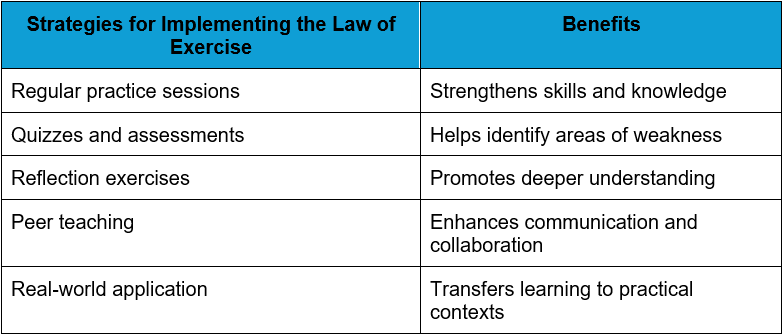
Strategies for Implementing the Law of Exercise
Implementing the law of exercise effectively in instructional design requires careful planning and thoughtful strategies. By incorporating the following techniques, instructional designers can create a dynamic learning experience that leverages the power of practice and repetition.
1. Provide opportunities for frequent practice and repetition: One of the key pillars of the law of exercise is the idea of repetitive practice. To implement this, designers can include interactive exercises and activities that allow learners to apply and reinforce their knowledge. These can range from quizzes and problem-solving tasks to simulations and real-world scenarios.
2. Incorporate review and summary activities: Regular review and summary activities help learners consolidate their understanding and reinforce the connections between different concepts. Designers can include periodic quizzes, concept maps, or interactive summaries that prompt learners to revisit and synthesize what they have learned.
3. Offer feedback and reinforcement: Feedback plays a crucial role in the learning process. By providing timely and constructive feedback, designers can guide learners in correcting mistakes, clarifying misconceptions, and reinforcing correct responses. This can be done through written feedback, immediate feedback within interactive exercises, or even personalized feedback from instructors.
4. Use techniques such as demonstrations, role-playing, and peer teaching: Active engagement is essential for effective learning. Designers can incorporate techniques such as demonstrations, role-playing, and peer teaching to encourage learners to actively participate in the learning process. These activities provide hands-on experience, promote critical thinking, and enhance skill development.
"Repetition is the key to mastery. By implementing strategies that provide opportunities for practice, repetition, and active engagement, instructional designers can create highly effective learning experiences."
By employing these strategies, instructional designers can harness the power of the law of exercise to enhance learning outcomes. Keep in mind that the specific strategies chosen should align with the instructional goals, the target audience, and the nature of the content being taught. When implemented effectively, these strategies can create a dynamic and engaging learning experience that helps learners develop a deep and lasting understanding of the material.
Considerations for Successful Application of the Law of Exercise
There are several key considerations that instructional designers should consider to successfully apply the law of exercise in instructional design. These factors play a crucial role in optimizing the learning experience and ensuring that learners can effectively use and reinforce their knowledge and skills.
Prior Knowledge and Skill Level
One important consideration is the learners' prior knowledge and skill level. Instructional designers must assess the learners' starting point and design activities suitable for their current abilities. By understanding the learners' existing knowledge and skills, designers can tailor the practice and repetition activities to meet their specific needs and promote gradual progression.
Complexity of the Learning Task
The complexity of the learning task also needs to be taken into account. Instructional designers should carefully consider the difficulty level and the task's cognitive demands. If the task is too easy, learners may not be adequately challenged; if it is too difficult, learners may become frustrated and discouraged. By striking the right balance, designers can provide learners with meaningful practice and reinforcement opportunities.
Clear Objectives and Guidance
Clear objectives and guidance are essential to effectively applying the law of exercise. Learners should clearly understand the purpose and expectations of the practice activities. Instructional designers must clearly communicate the desired learning outcomes and provide step-by-step guidance on how to perform the practice tasks. This clarity helps learners stay focused and motivated throughout the learning process.
Regular Assessments and Self-Reflection
Incorporating regular assessments and opportunities for self-reflection is another vital consideration. Assessments allow designers to gauge learner progress and identify areas that require further practice and reinforcement. Self-reflection activities enable learners to evaluate their performance and identify areas for improvement. By incorporating these assessments and reflective practices, instructional designers can enhance the application of the law of exercise and facilitate deeper learning.
By considering these considerations, instructional designers can effectively apply the law of exercise in their design and create engaging learning experiences that promote lasting retention and skill development.
Conclusion
In conclusion, the law of exercise is a crucial component of instructional design and the broader framework of the six laws of learning. By emphasizing practice and repetition, this law helps learners strengthen their understanding and retention of the material. When integrated with the other laws of learning, the law of exercise can contribute to the development of effective instructional strategies that enhance the educational experience.
By mastering these laws, instructors can unlock the potential of instructional design and create powerful learning opportunities for their students. The six laws of learning, including the law of exercise, provide a comprehensive framework for designing instruction that promotes optimal learning outcomes. By understanding and applying these laws, instructors can enhance learner motivation, engagement, and retention, leading to improved instructional experiences for learners.
Instructional design is a dynamic field that evolves as new research and technologies emerge. Instructors can incorporate evidence-based practices into their teaching methods by staying informed about the six laws of learning and their application in instructional design. Done correctly, instructors can create engaging, effective, and impactful learning experiences for their students.
FAQ
The law of exercise states that the more frequently a stimulus and response are associated, the more likely the particular response will follow the stimulus. This law emphasizes the importance of practice and repetition in learning.
Instructional designers can incorporate the law of exercise by providing opportunities for learners to engage in meaningful practice and repetition. This can be done through drills, review sessions, and summary activities.
The law of exercise helps learners strengthen their understanding and retention of the material. It also promotes the development of learning habits and can improve motivation and engagement.
The law of exercise should be considered in conjunction with the other five laws of learning to create a comprehensive instructional design. By integrating the law of exercise with these laws, instructional designers can create a holistic and effective learning experience.
Strategies for implementing the law of exercise include providing opportunities for frequent practice and repetition, incorporating review and summary activities, and offering feedback and reinforcement.
Instructional designers should consider factors such as the complexity of the learning task, learners' prior knowledge and skill level, and the desired learning outcomes. Providing clear objectives and guidance is also important.
Source Links
SHARE


Subscribe now.
Instructional design, learning development, theory and application, software, and more!
QUICK LINKS
Copyright © 2024 All Rights Reserved. Learning Developers Group and Learning Dev with Dr. D are owned and operated by Dean Reed, LLC